Laureate of the Laboratory for Excellence project (LabEx) in the program « Investment in the future », the DRIIHM LabEx, InterDisciplinary Research Facility on Human-Environment Interactions, aggregate 131 human-environments observatories (OHM in french), tools for observing socio-ecosystems impacted by anthropic events. Created by CNRS-INEE in 2007, they are located in metropolitan France (6: Bassin Minier de Provence (provence Coalfield), Pyrénées-haut Vicdessos, Vallée du Rhône (Rhone valley), Littoral Méditerranéen (French mediterranean coastal zone), Pays de Bitche (Bitche County) and Fessenheim), overseas France (2: Oyapock (French Guyana), Littoral caraïbe (Caribbean Coast)) and abroad (5: Estarreja (Portugal), Téssékéré (Sénégal), Nunavik (Canada), Pima County (USA), Patagonia-Bahia Exploradores (Chile)).
DRIIHM brings together over 1,400 research staff, including 300 foreigners, from 200 research units in 87 french and foreign universities, 46 research organizations and "Grandes Écoles". It has financed 960 research projects, supervised 190 doctorates, 110 post-doctorates and over 400 Master's degrees.
Le prochain séminaire de notre LabEx aura lieu à Brest, sur le campus de Plouzané, du 10 au 12 juin 2025. Il est organisé par l'OHM Littoral Caraïbe. Outre les sessions habituelles des actualités OHM / DRIIHM et des Posters, deux sessions thématiques seront présentées :
La matinée du 12 juin est réservée a une visite de terrain.
Vous trouverez toutes les informations pratiques ainsi que le formulaire d'inscription sur le site dédié : https://driihm2025.sciencesconf.org
Ne tardez pas ! L'inscription est libre, ouverte à tous mais obligatoire avant le 20 mai.
english version below
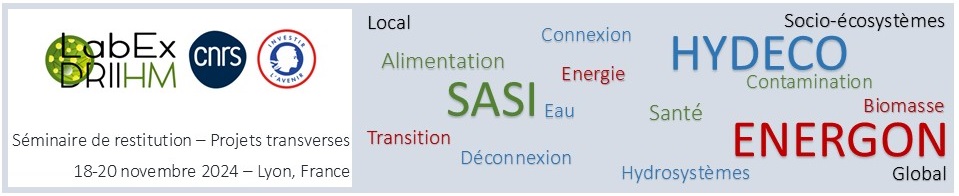
Les restitutions des trois projets transverses (2021-2024) auront lieu les 18 et 19 novembre prochains à l'amphithéâtre Descartes de l'ENS Lyon. Les équipes SASI, ENERGON et HYDECO présenteront les principaux résultats de leurs travaux.
Ces trois sessions sont ouvertes à tout public sur simple inscription sur le site dédié aux journées : https://transverses.sciencesconf.org/
La session "bilan et prospective" en matinée du 20 novembre est réservée aux chercheurs OHM.
Read more: Séminaire de restitution Projets Transverses - Ouverture des inscriptions
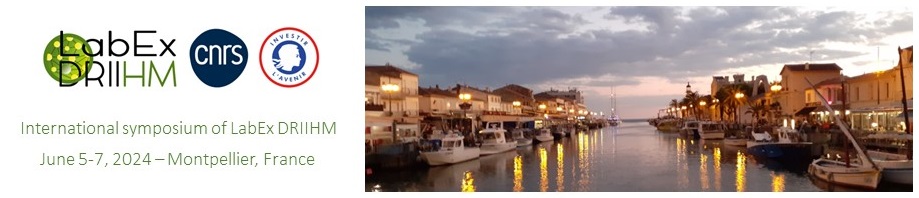
La 12ème édition du séminaire annuel du LabEx DRIIHM s’est tenue du 5 au 7 juin 2024 à la Faculté de pharmacie de Montpellier. Organisée par le LabEx DRIIHM et l’OHM Littoral méditerranéen, la communauté scientifique des 13 Observatoires Hommes-Milieux s’y est réunie afin d’échanger sur leurs travaux de recherche OHM et interOHM. Le séminaire est aussi l’occasion de contribuer à la construction de l'interdisciplinarité dans ces dispositifs d'observation de socio‑écosystèmes en crise.
Ces trois journées sont rythmées par des présentations, des tables rondes, des posters scientifiques et une sortie sur le terrain. Des acteurs territoriaux sont conviés à participer aux échanges, caractéristique essentielle des OHM : l’ancrage de leur recherche dans le territoire et la considération permanente du lien entre les acteurs locaux et les scientifiques.
A cette occasion, le LabEx DRIIHM a produit un court film afin de marquer l’événement.
English version below
Le séminaire du DRIIHM et des OHM a lieu cette année à Montpellier du 5 au 7 juin. Vous êtes tous cordialement invités.
Les inscriptions sont désormais ouvertes sur le site dédié : https://driihm2024.sciencesconf.org/
Vous y trouverez toutes les informations nécessaires pour organiser votre venue ainsi que le pré-programme de ces journées.
N'hésitez pas à vous y inscrire et à transmettre dans votre réseau.
Read more: Séminaire 2024 du DRIIHM et des OHM - Inscrivez-vous !
English version below
Vous avez jusqu'au 1er avril pour nous soumettre votre résumé.
Dans l'un cadre d'un ou plusieurs projets réalisés sur un territoire OHM, vous avez travaillé, de manière ponctuelle ou sur du plus long terme, sur les questions d'interfaces Biodiversité et Société ?
Venez présenter les résultats de vos travaux lors du séminaire thématique qui aura lieu les 3 et 4 juin 2024 à Montpellier.
Le plus grand nombre de ces présentations aura vocation à être publié dans un numéro spécial d'une revue internationale.
Vous pouvez prendre connaissance de l'intégralité de l'appel à communication ainsi que les modalités de soumission des propositions en cliquant ICI.
___________________________________
You have until April 1st to submit your abstract.
As part of one or more projects carried out on an OHM territory, you have been working, on a one-off or longer-term basis, on issues at the interface between biodiversity and society?
Present the results of your research at the thematic seminar to be held on June 3 and 4, 2024 in Montpellier.
Most of these presentations will be published in a special issue of an international journal.
You can read the full call for papers and details of how to submit proposals by clicking HERE.
The LabEx DRIIHM geocatalogue has today joined a new shared catalogue: cat.InDoRES. The aim of this catalogue is to bring together the metadata from different organisations such as DRIIHM and its OHMs and the Zones Ateliers, in order to combine the metadata in a common catalogue and also to factorise the IT maintenance effort. This project is supported by the CNRS Ecology and Environment Institute and the Muséum national d'Histoire naturelle.
The geo.driihm.fr catalogue is no longer active. The LabEx DRIIHM geocatalogue is now part of the shared cat.indores.fr catalogue.
You can access the LabEx DRIIHM portal directly at the following address: cat.indores.fr/geonetwork/driihm. You will find the sub-portals by OHM as they were available on the geo.driihm.fr catalogue.
If you had an account on geo.driihm.fr, you can contact the administrator (
Page 1 of 13
 Fr
Fr En
En