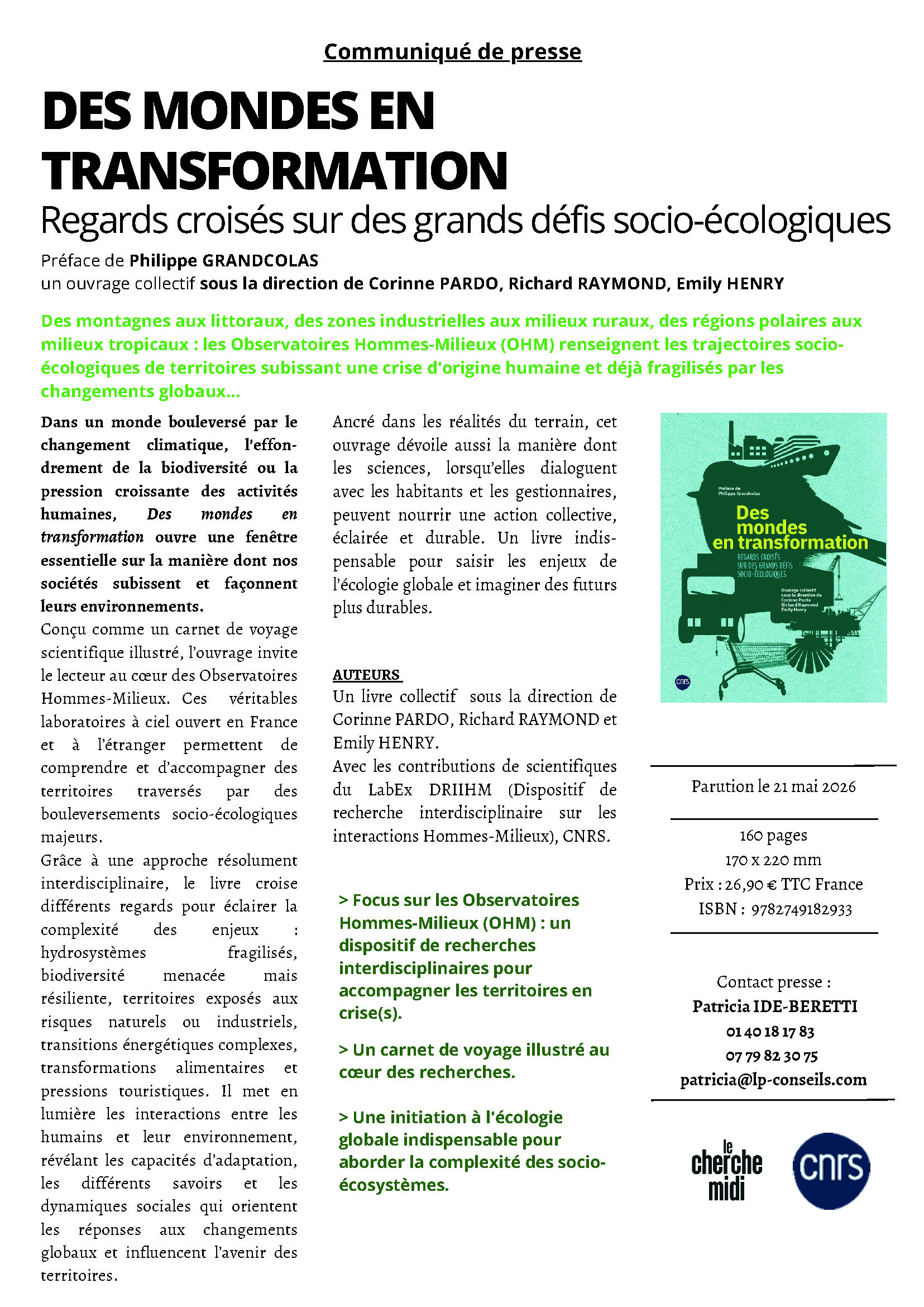
Laureate of the Laboratory for Excellence project (LabEx) in the program « Investment in the future », the DRIIHM LabEx, InterDisciplinary Research Facility on Human-Environment Interactions, aggregate 131 human-environments observatories (OHM in french), tools for observing socio-ecosystems impacted by anthropic events. Created by CNRS-INEE in 2007, they are located in metropolitan France (6: Bassin Minier de Provence (provence Coalfield), Pyrénées-haut Vicdessos, Vallée du Rhône (Rhone valley), Littoral Méditerranéen (French mediterranean coastal zone), Pays de Bitche (Bitche County) and Fessenheim), overseas France (2: Oyapock (French Guyana), Littoral caraïbe (Caribbean Coast)) and abroad (5: Estarreja (Portugal), Téssékéré (Sénégal), Nunavik (Canada), Pima County (USA), Patagonia-Bahia Exploradores (Chile)).
DRIIHM brings together over 1,400 research staff, including 300 foreigners, from 200 research units in 87 french and foreign universities, 46 research organizations and "Grandes Écoles". It has financed 960 research projects, supervised 190 doctorates, 110 post-doctorates and over 400 Master's degrees.
L'OHM Fessenheim recrute un stagiaire sur la thématique : Exploitation des archives INA pour reconstituer une histoire audiovisuelle de la centrale nucléaire de Fessenheim.
Ce stage s’inscrit dans les recherches de l’Observatoire Hommes Milieux (OHM) Fessenheim, hébergé au Laboratoire Image, Ville, Environnement (LIVE UMR 7362 CNRS) de l’Université de Strasbourg.
Pour en savoir plus sur le contenu du stage : https://calenda.org/1410997
Le recrutement se fera sur les mois de juin et juillet et un entretien pourra avoir lieu sur cette même période.
La durée de stage sera de 4 à 6 mois selon les attendus de la formation de l'étudiant retenu.
Les candidatures (CV + lettre de motivation + Relevé de notes) seront adressées avant le 30 juin 2026 à :

Our next seminar will take place from June 22 to 24 at the IPHC in Strasbourg.
Registration is open until May 20. In addition to the registration form, you will find all the necessary information about the event: the premiminary program, directions to the IPHC, details about the field trips, a template for PowerPoint presentations, and guidelines for the “Posters” session.
The website is available in two languages:
Reminder: You must have an account to register. If you do not have one yet, you can either log in with your HAL logins or create an SciencesConf account: https://driihm2026.sciencesconf.org/user/createaccount
Don’t wait to register!
Our LabEx’s next seminar will take place in Strasbourg at the IPHC on the Cronenbourg campus, 23 rue du Loess, from June 22 to 24, 2026. It is organized by the DRIIHM and, locally, by the OHM Fessenheim.
We will soon share the link to the sciencesConf website for registration and so you can review the seminar agenda.
In the meantime, please mark these dates on your calendars.
We look forward to seeing many of you there.
English version below
L'appel à projets de recherche 2026 du DRIIHM et des OHM est encore ouvert jusqu'au 15 décembre minuit heure de Paris.
Ne tardez plus !
Les projets lauréats de cet appel seront connus courant janvier 2026.
Vous trouverez toutes les informations pour soumettre un projet dans l'article dédié à l'ouverture de cet appel.
-------
The 2026 call for research proposals from DRIIHM and the OHMs remains open until midnight Paris time on December 15.
Don’t wait any longer!
The winning projects from this call will be announced in January 2026.
You can find all the information you need to submit a proposal in the article announcing this call.
The ENERGON 2025 Symposium: Energy Transition and Territorial Reconfigurations was held at the MMSH in Aix-en-Provence on November 20 and 21. It brought together approximately 100 researchers for an opening lecture, 27 presentations, and a roundtable discussion.
These two days marked the culmination of a cross-cutting research project involving six Human-Environment Observatories: two abroad—the OHMi Nunavik (Canada) and Pima County (Arizona, USA)—and four in mainland France: the OHM Pays de Bitche (Moselle), Fessenheim (Haut-Rhin), Vallée du Rhône, and finally Bassin Minier de Provence, which, through Sylvie Daviet, served as the lead and coordinator of this three-year project (2021–2024). "The ENERGON project was both retrospective and exploratory: retrospective because it built on the findings of many years of research on various energy-related issues in the participating OHMs (production, infrastructure, institutional and political frameworks, controversies, etc.), but also exploratory because it proposed testing an original Nexus-based approach. As recently as 2021, research on the localized impact of energy transitions remained largely sector-specific and narrow in scope. ENERGON’s success lay in overcoming this compartmentalization by integrating the social, technical, and environmental dimensions specific to each socio-ecosystem through the “Society-Technology-Environment” nexus approach, which made it possible to assess the impact of specific energy choices on these three components; with each of the OHMs involved serving as a real-world laboratory to test this approach while taking into account the specific characteristics of its socio-ecosystem" (C. Pardo, LabEx DRIIHM, November 2025).
Over these two days, ENERGON thus demonstrated its ability to attract and mobilize, through its original approach, a broader interdisciplinary community that strengthens the DRIIHM and OHM communities. While this seminar marks the conclusion of a project, it most certainly signals the beginning of new and fruitful collaborations.
Presentation of the conference by Sylvie Daviet, Professor of Geography and co-organizer of the conference
The DRIIHM and OHM 2026 call for research projects is now open.
The general framework (VF/ENG) of the call contains all the scientific, administrative, and technical information you need to submit a proposal.
To familiarize yourself with the project submission form and the steps to follow on the platform, please read the Online Submission Guide.
You can also consult the research priorities for each of the 14 OHM calls directly via the links below:
>>>> The inter-OHM call for projects is open until midnight on December 15.
The winning projects from this call will be announced in January 2026.
Page 1 of 13
 Fr
Fr En
En